
close
Choose Your Site
Global
Social Media
Views: 0 Author: Site Editor Publish Time: 2026-05-27 Origin: Site


A Condensing Unit serves as the financial and operational engine of any cold storage facility. It continuously drives the refrigeration cycle to keep perishable goods perfectly chilled. Selecting the right equipment dictates whether your facility thrives or struggles on a daily basis. Poor selection raises the stakes significantly for facility managers. Undersizing leads to constant system strain, inadequate cooling, and devastating product spoilage. Conversely, oversizing causes inefficient short-cycling and unnecessarily inflates your initial capital expenditure. We need a much better approach to industrial equipment procurement. This guide introduces a highly structured, engineering-led evaluation framework to help you navigate these choices. You will learn how to transition from basic specification matching to strategic, compliance-driven decisions. We will thoroughly explore cooling capacity metrics, modern compressor technologies, and component synergy. By the end, you will understand how to secure optimal long-term cooling performance for your specialized operations.
Accurate cooling capacity requires calculating peak thermal loads, not just room volume, to prevent compressor short-cycling or temperature drift.
Regulatory shifts toward low-GWP and A2L refrigerants require future-proofing equipment choices to avoid premature obsolescence.
A condensing unit must be matched precisely with the evaporator and expansion valve; isolated purchasing often leads to liquid slugging or inadequate cooling.
Evaluating Total Cost of Ownership (TCO) means factoring in local ambient conditions, AWEF efficiency ratings, and long-term maintenance accessibility over initial sticker price.
First, you must clearly define the operational temperature zone for your facility. Specific perishable products demand exact temperature requirements to prevent bacterial growth. Dairy products require chillers operating safely between 0–10°C (34°F–38°F). Frozen foods need dedicated freezers running from -18°C to -25°C. Industrial blast freezers must rapidly drop core temperatures below -30°C. You must match your equipment specifically to these distinct thermal zones.
Application Type | Target Temperature Range | Common Product Storage |
|---|---|---|
Medium Temp (Chiller) | 0°C to 10°C (34°F to 50°F) | Dairy, Fresh Produce, Beverages |
Low Temp (Freezer) | -18°C to -25°C (-0.4°F to -13°F) | Frozen Meat, Ice Cream, Packaged Meals |
Ultra-Low (Blast Freezer) | -30°C to -40°C (-22°F to -40°F) | Rapid Seafood Freezing, Medical Supplies |
Next, you must calculate the true heat load variables. You cannot rely on empty room volume alone. Accurate BTU/hr or kW sizing requires several highly specific data inputs. Relying on guesswork usually leads to catastrophic system failures.
Product Ingress Temperature: Calculate the heat energy brought in by newly delivered pallets. Hotter incoming goods require significantly more cooling power.
Air Infiltration Rates: Track your daily door opening frequency. Every open door invites warm, humid air into the cold room.
Panel Insulation Values: Check your polyurethane panel thickness. A 150mm panel blocks heat transfer much better than a 100mm panel.
Internal Heat Gains: Factor in the continuous heat generated by bright internal lighting, forklift motors, and warehouse personnel.
Improper sizing creates severe physical consequences for your system infrastructure. Oversizing leads to rapid, aggressive temperature drops inside the room. This causes the compressor to short-cycle continuously. Short-cycling quickly destroys electrical contactors and ruins compressor windings. Undersizing creates the exact opposite problem. The system runs endlessly in a strained, inefficient state. It repeatedly fails to reach critical target temperatures. This ultimately compromises food safety and destroys valuable inventory.
You must carefully choose between monoblock and split system architectures. Your facility layout heavily dictates this choice.
Monoblock, or packaged units, offer a simple plug-and-play solution. Manufacturers pre-charge these units with refrigerant at the factory. They work best for small, indoor walk-in coolers. However, you can only deploy them if your building space allows for internal heat exhaust. They expel rejected heat directly into the adjacent room. You must have excellent warehouse ventilation to prevent severe overheating.
Split, or remote systems, are entirely mandatory for larger commercial footprints. You also need them in noise-sensitive retail areas. Split systems separate the noisy compressor from the quiet indoor evaporator. They safely reject excess system heat outdoors. This setup requires complex copper pipe routing and careful oil return management.
Compressor technology dictates your long-term energy consumption and maintenance schedules. You must evaluate three primary categories.
Hermetic Compressors: These fully sealed units offer cost-effective operation for light commercial use. They run quietly and require minimal initial setup. However, technicians cannot repair them in the field. A mechanical failure requires a complete compressor replacement.
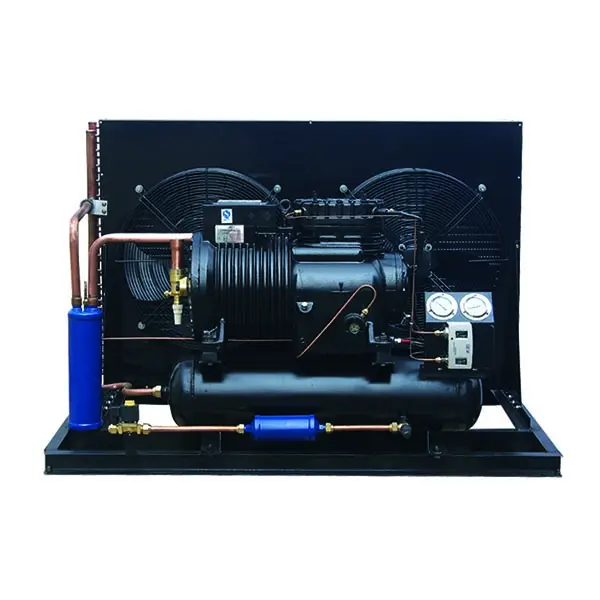
Semi-Hermetic Compressors: These remain the undisputed industry standard for heavy commercial use. Cast-iron semi-hermetic models offer incredible durability. Technicians can unbolt the housing to fully service internal valves and pistons. They deliver excellent long-term return on investment.
Scroll & Inverter-Driven Compressors: These utilize modern variable speed drive (VSD) technology. They adapt perfectly to environments experiencing heavily fluctuating heat loads. They offer massive energy savings by matching compressor speed to real-time cooling demand. They completely eliminate aggressive power spikes during startup.
You must actively future-proof your refrigerant choices today. Environmental agencies worldwide are rapidly phasing down high-GWP (Global Warming Potential) HFCs like R-404A. Buying legacy equipment risks severe regulatory penalties and future refrigerant shortages. We strongly recommend evaluating modern, compliant alternatives.
Engineers currently favor A1 low-GWP alternatives. Options like R-448A and R-449A provide excellent transitional solutions for existing facility upgrades. You should also deeply consider A2L mildly flammable refrigerants. Natural refrigerants like CO2 (R-744) offer the ultimate strict ESG compliance. CO2 systems guarantee long-term operational viability, though they operate at much higher physical pressures.
Refrigerant Type | Classification | GWP Value | Long-Term Viability |
|---|---|---|---|
R-404A | A1 (Non-flammable) | 3,922 | Poor (Facing aggressive phase-downs) |
R-448A / R-449A | A1 (Non-flammable) | ~1,273 to 1,397 | Moderate (Good transitional drop-in) |
R-454C | A2L (Mildly Flammable) | 148 | Strong (Excellent future-proofing) |
R-744 (CO2) | A1 (Natural) | 1 | Excellent (Ultimate ESG compliance) |
You must intimately understand specific refrigerant performance characteristics. Modern blended refrigerants often exhibit a phenomenon called "temperature glide." The refrigerant phase changes across a range of temperatures rather than a single fixed point. This technical glide can artificially degrade overall system capacity. You must factor this glide into your initial engineering calculations. If you ignore it, your equipment will underperform severely during peak summer heat waves.
Finally, you must rigorously verify modern efficiency metrics. Smart buyers always look beyond baseline SEER or EER ratings. Emphasize strict compliance with current Department of Energy (DOE) regulations. You should prioritize the Annual Walk-In Energy Factor (AWEF). A strong AWEF rating guarantees actual, verifiable operational efficiency for commercial cold storage applications.
A heavy-duty Condensing Unit cannot operate successfully in isolation. It relies entirely on seamless evaporator synergy. You must pair the outdoor equipment with a precisely sized indoor evaporator coil. Component mismatching destroys energy efficiency immediately.
If your local ambient temperatures run exceptionally high, you must adjust your engineering design. You will need significantly enlarged condenser coils. These larger outdoor coils ensure adequate heat rejection during brutal summer conditions. Standard coils will cause the system to trip on high-pressure limits.
Expansion valve coordination remains equally critical to system health. You must perfectly match thermal expansion valves (TXV) or electronic expansion valves (EEV) to your system capacity.
Oversized Valves: These introduce severe mechanical risks. They flood the evaporator and cause compressor liquid slugging. Liquid refrigerant enters the compressor block and shatters internal valves.
Undersized Valves: These severely restrict the necessary refrigerant flow. This starves the evaporator coil entirely. The room fails to cool, and the compressor overheats from lack of return gas cooling.
Electronic Advantages: EEVs offer far tighter superheat control than mechanical TXVs. They utilize digital sensors to save massive amounts of energy during low-load conditions.
Smart controllers completely revolutionize modern defrost management. Advanced IoT controllers act as a powerful risk-mitigation tool for facility managers. They facilitate proactive predictive maintenance across your entire refrigeration fleet. These intelligent systems optimize defrost cycles based on actual, measured frost buildup. They boldly abandon rigid, inefficient timer-based schedules. This keeps your evaporator coils impeccably clean while slashing unnecessary electrical heater usage.
Site-specific environmental risks dictate your entire installation strategy. Outdoor equipment faces numerous hostile physical location constraints. You must carefully evaluate equipment exposure to highly corrosive local environments.
Coastal sea salt and industrial chemical exhaust degrade standard aluminum fins rapidly. In these environments, you must specify epoxy-coated condenser coils. Direct solar gain forces the compressor to work much harder. You should install sunshades to protect the machinery. Prevailing winds can easily disrupt proper condenser fan airflow. Strong headwinds cause high head pressure faults. Technicians often install customized wind baffles to redirect aggressive air currents.
Physical setup requirements demand strict, unwavering attention from installers.
Vibration Management: Installers must use high-quality vibration-dampening mounts. These prevent harmonic resonance from tearing copper pipes apart.
Foundation Stability: Technicians must pour level concrete pads. Uneven surfaces cause compressor oil starvation and premature bearing failure.
Drainage Logistics: Proper drainage planning prevents stagnant water pooling. Defrost cycles produce gallons of water daily. You must install heat trace tape on drain lines in freezing environments to prevent ice blockages.
You must intelligently balance your upfront budget against long-term operational economics. Advanced variable-speed, low-GWP systems naturally require a higher initial capital expenditure. However, they deliver substantial, verifiable long-term financial benefits. You will see significant savings in your monthly electrical utility bills. You will experience drastically reduced product spoilage rates. You will also face far less maintenance downtime over an expected 10-to-15-year equipment lifespan.
Choosing the right refrigeration equipment remains a serious engineering decision. It is never a simple, purely price-driven commodity purchase. You must intelligently balance thermal load physics with increasingly strict environmental regulatory compliance. Operational success requires flawless system-wide component integration.
We highly advise buyers to apply strict shortlisting logic during procurement. Immediately eliminate vendors who quote equipment based purely on square footage. A reputable, professional vendor always asks for product heat load data and local ambient condition statistics.
Take immediate action to secure your facility's operational future. Consult with a qualified commercial refrigeration engineer today. Request a customized thermal calculation sheet for your specific warehouse project. Align your exact daily BTU requirements with verified, published manufacturer specifications to guarantee lasting success.
A: You must conduct a formal heat load calculation using BTU/hr or Watts. Never size equipment based solely on floor space. You must factor in panel insulation thickness, total product volume, and ingress temperature. Additionally, account for peak outdoor ambient temperatures and daily door opening frequencies.
A: Commercial units typically last between 10 to 15 years. This lifespan heavily depends on proactive preventive maintenance. Regular condenser coil cleaning, proper oil management, and correct initial sizing prevent destructive short-cycling and extend equipment life significantly.
A: Sometimes, but you face strict compatibility constraints. You must perfectly match cooling capacities, expansion valve parameters, and refrigerant types. Mismatched systems often suffer from poor oil return and inadequate cooling. Furthermore, mixing different manufacturer components frequently voids factory warranties.
A: Continuous operation indicates a severe system stressor. Likely causes include severely undersized equipment, a significant refrigerant leak, or heavily frosted evaporator coils. Extreme outdoor ambient temperatures exceeding original design specifications can also force the compressor to run without stopping.


