
close
Choose Your Site
Global
Social Media
Views: 0 Author: Site Editor Publish Time: 2026-07-07 Origin: Site


Commercial and industrial freezing carries enormous stakes. Equipment failure means massive product loss, catastrophic downtime, and skyrocketing energy consumption. Low-temperature refrigeration presents a unique engineering challenge. High compression ratios place intense thermal and mechanical stress on the system. You need reliable performance to keep operations running smoothly. A Semi-hermetic Reciprocating Compressor stands as the industry standard. It perfectly balances heavy-duty performance with exceptional long-term serviceability. Throughout this guide, you will learn exactly how these systems operate under extreme conditions. We will explore their core advantages, evaluate competitive alternatives, and outline essential procurement steps. By understanding these mechanical principles, you can make informed infrastructure decisions. This ensures your frozen inventory remains protected year-round. You will discover practical ways to optimize efficiency. We will also highlight common pitfalls to avoid during installation. Let us dive into the mechanics.
Serviceability over replacement: Bolted cast-iron casings allow for in-field repairs (valve plates, pistons) without cutting the shell, drastically reducing long-term replacement costs.
Low-temperature efficiency: Volumetric efficiency remains stable even at deep-freeze evaporation temperatures.
TCO justification: Higher initial CapEx is offset by an extended lifecycle, capacity control capabilities, and reduced maintenance-related downtime.
Risk mitigation: Eliminates the shaft-seal leakage risks associated with open-drive compressors while offering more durability than fully hermetic alternatives.
Baseline expectations for industrial freezers are incredibly strict. Facilities demand constant 24/7 duty cycles. Food safety regulations require stringent temperature holding capabilities. Modern energy standards mandate high efficiency. Any slight deviation risks widespread inventory spoilage. Deep freezing involves pulling heat from sub-zero environments. This specific physics requires high pressure differentials. The suction pressure remains very low inside the evaporator. Meanwhile, the discharge pressure stays high to reject heat outdoors.
This high compression ratio creates elevated discharge temperatures. Light-duty units often burn out under this intense thermal load. Their internal components degrade fast. We must define success criteria clearly during the decision stage. A viable piece of equipment needs a predictable lifecycle. It must offer ease of maintenance. It also requires excellent energy efficiency at partial loads. You cannot afford unexpected shutdowns. Predictability keeps operations profitable. A heavy-duty framework ensures stability.
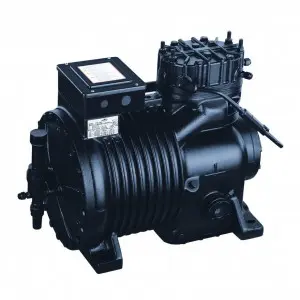
Reciprocating technology relies on precise piston-cylinder mechanics. This design maintains steady cooling capacity constantly. Suction pressures drop significantly in freezer applications. Still, the piston continues to draw and compress gas effectively. We see excellent volumetric efficiency at deep-freeze evaporation temperatures. Tight clearance volumes prevent refrigerant from remaining in the cylinder. This maximizes the intake of fresh gas.
It handles sub-zero freezing effortlessly. It also manages blast freezing operations reliably. Blast freezers demand rapid temperature drops. Food processors rely on this speed to lock in freshness. The robust valve plates ensure tight seals during compression. This minimizes blow-by gases. Your system maintains target temperatures without running continuously.
Modern configurations integrate smoothly into smart facilities. They pair perfectly with Variable Frequency Drives (VFDs). You can also utilize mechanical cylinder unloading. This adjusts the cooling output to match the actual load dynamically. Precise load-matching reduces short-cycling significantly.
Short-cycling occurs when a unit turns on and off rapidly. It wastes electricity. It also causes severe mechanical wear on the motor. VFDs allow the motor to spin slower during low-demand periods. This saves energy instantly. It extends the equipment lifecycle. You avoid the massive power spikes caused by frequent hard starts.
The term "semi-hermetic" highlights a brilliant engineering choice. The suction refrigerant flows directly over the motor before entering the cylinders. This returning gas is very cold. It absorbs heat generated by the electrical windings. This internal cooling prevents motor burnout effectively.
High-stress environments normally destroy externally driven motors. The internal thermal management keeps stator temperatures completely safe. You get uninterrupted performance even during peak summer ambient conditions. Overheating is the primary killer of refrigeration electronics. This suction-cooling design mitigates that risk entirely.
Hermetic units feature fully welded steel shells. You cannot open them under any circumstances. If a single internal component fails, you replace the entire unit. This leads to high industrial waste. It also creates steep replacement costs. You lose days waiting for a new unit to arrive.
In contrast, bolted cast-iron construction defines the semi-hermetic option. Technicians can unbolt the casing easily. They rebuild the machine on-site. They replace valve plates, pistons, or stators directly. This shifts the focus from constant capital expenditures to manageable operational repairs. A reliable freezer compressor should outlast a single component failure. You repair it and resume operations quickly.
Open-drive models use separate, external motors. They connect via exposed rotating shafts. This requires mechanical shaft seals. These seals constantly degrade through friction. They leak refrigerant over time inevitably. Leaks create major compliance issues. They harm the environment. They also waste expensive refrigerant gas.
A semi-hermetic housing encloses both the motor and compression mechanism together. It eliminates the shaft seal entirely. You achieve total refrigerant containment. Yet, you never sacrifice serviceability. You get the environmental safety of a hermetic shell. You get the repairability of an open-drive model.
Compressor Type | Serviceability | Refrigerant Leak Risk | Initial Cost | Lifespan Potential |
|---|---|---|---|---|
Fully Hermetic | None (Must replace) | Very Low | Low | Short to Medium |
Open-Drive | High (Fully accessible) | High (Shaft seals) | High | Long |
Semi-Hermetic | High (Bolted casing) | Very Low (No shaft seal) | Moderate to High | Very Long (Rebuildable) |
Every technology carries specific implementation realities. You must plan for physical and mechanical constraints. Ignoring these details leads to premature failures.
These machines are exceptionally heavy. They utilize thick cast iron for durability. They require larger footprints than scroll or hermetic counterparts. You must install robust mounting structures. Vibration isolation is critical for long-term health. Spring mounts prevent structural damage. Heavy-duty rubber pads isolate low-frequency vibrations. Flexible piping joints prevent copper line fractures.
Reciprocating pistons generate operational noise. You must address this realistically during facility design. Noise-sensitive environments require careful planning. You should place them in dedicated mechanical rooms. Acoustic blankets can dampen high-frequency sounds. Sound enclosures block radiant noise effectively. Do not place these units directly above quiet office spaces.
You must future-proof your installation immediately. Select models validated for modern low-GWP refrigerants. Regulations are phasing down older hydrofluorocarbons globally. Proper compatibility prevents expensive future retrofits. Ensure the internal seals match the chosen gas. Choose the correct synthetic lubricants.
Follow these essential implementation steps:
Conduct a load audit: Measure your peak cooling requirements accurately.
Select the refrigerant: Choose a low-GWP gas compliant with local regulations.
Design the mounting platform: Engineer a reinforced base to handle the cast-iron weight.
Install vibration isolators: Fit spring mounts and flexible discharge lines.
Implement oil management: Install crankcase heaters and oil separators for low-temp stability.
Selecting the right hardware is only half the battle. Your relationship with the manufacturer matters immensely. Supply chain reliability determines your facility uptime. A serviceable unit needs readily available replacement parts. You need gaskets, valve plates, and piston rings shipped fast. If parts take weeks to arrive, the rebuild advantage disappears entirely.
Factory testing ensures out-of-the-box quality. Look for manufacturers conducting rigorous run-testing. They must test under specific low-temp conditions before shipping. Technical support holds immense value during installation. Evaluate the manufacturer's documentation carefully. Ensure warranty terms are clear. Strong engineering support aids custom sizing. It simplifies complex system integration.
Use the following checklist chart to evaluate potential suppliers:
Evaluation Criteria | What to Look For | Red Flags to Avoid |
|---|---|---|
Parts Availability | Domestic warehousing, overnight shipping options, standard gasket kits. | Proprietary parts with long overseas lead times. |
Factory Testing | Run-tested under actual load, leak-tested via helium mass spectrometry. | Only dry-tested or air-tested on the assembly line. |
Technical Support | Direct access to application engineers, clear selection software. | Only basic PDF manuals, poor warranty clarity. |
Choosing this technology represents a robust infrastructure investment. It perfectly protects your high-value frozen inventory. You gain superior volumetric efficiency at extreme temperatures. You eliminate costly full-unit replacements through on-site serviceability. The internal motor cooling prevents thermal breakdowns entirely. You must audit your current freezer loads today. Calculate the true financial impact of an unexpected shutdown. Consult directly with a qualified refrigeration engineer. They will help you specify the correct displacement and motor size. Upgrading your core hardware guarantees operational peace of mind.
A: It depends on the scale. For small, light-duty commercial walk-ins, a fully hermetic unit often suffices due to lower initial costs. However, for heavy-duty walk-ins, blast freezers, or large industrial cold storage, the semi-hermetic option is superior. Its longevity and rebuildability offer a better return on investment over a decade of heavy use.
A: Maintenance intervals depend on operating hours. Generally, you should perform visual inspections and check oil levels quarterly. Perform vibration analysis and oil acidity tests annually. Valve plate inspections and deep internal maintenance are usually recommended every 10,000 to 15,000 operating hours, depending on the duty cycle.
A: Yes, retrofits are highly common. However, you must account for changes in physical footprint and weight. You will likely need to upgrade the mounting rails and vibration isolators. Additionally, verify that the electrical phasing and pipe sizing match the new unit's exact specifications.
A: A fully hermetic unit has a hard stop at failure, typically lasting 5 to 10 years. A well-maintained semi-hermetic unit is fully rebuildable. By replacing wear parts like pistons and stators, you can rebuild it multiple times. This effectively doubles or triples its operational life, often exceeding 20 years.


