
close
Choose Your Site
Global
Social Media
Views: 0 Author: Site Editor Publish Time: 2026-02-03 Origin: Site


A semi-hermetic reciprocating compressor is a type of positive displacement compressor that uses a piston-driven mechanism to compress refrigerant gas within a cylinder. In semi-hermetic designs, the motor and compressor components are housed in a sealed, but accessible casing, making maintenance easier compared to fully hermetic compressors. These compressors are known for their reliability, durability, and ability to handle high pressures and fluctuating loads.
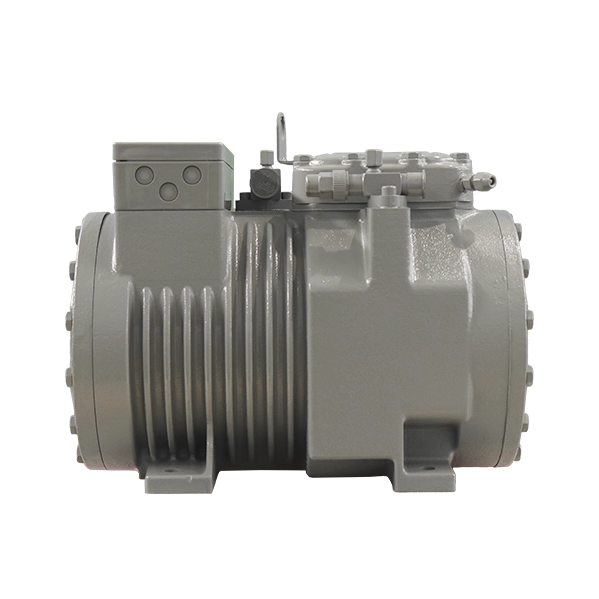
Energy Efficiency: Semi-hermetic reciprocating compressors are designed to minimize refrigerant leakage and optimize energy consumption.
Durability: These compressors are built for heavy-duty applications and offer long service life with proper maintenance, thanks to their robust design.
Serviceability: The semi-hermetic design allows easy access to internal components for repairs and part replacements without having to replace the entire compressor.
High Pressure Handling: They are capable of handling high-pressure refrigeration systems, making them ideal for industrial applications.
A scroll compressor is another type of positive displacement compressor that uses two interleaved spiral-shaped scrolls to compress refrigerant. One of the scrolls remains stationary while the other orbits around it. As the refrigerant moves through the scrolls, it is gradually compressed, resulting in a higher-pressure output. Scroll compressors are typically quieter and more compact than reciprocating compressors, making them suitable for a variety of residential and commercial applications.
Quiet Operation: Scroll compressors are known for their quiet operation, making them suitable for noise-sensitive environments.
Compact Design: Their design is generally more compact and lightweight compared to reciprocating compressors.
High Efficiency: Scroll compressors have fewer moving parts than reciprocating compressors, which can result in higher efficiency and lower maintenance needs.
Reliability: Scroll compressors are known for their reliability and are commonly used in refrigeration systems.
The most significant difference between a semi-hermetic reciprocating compressor and a scroll compressor lies in the way they compress refrigerant.
Semi-Hermetic Reciprocating Compressor: This type of compressor uses a piston mechanism to compress the refrigerant gas inside a cylinder. The piston moves up and down within the cylinder, drawing in refrigerant and compressing it to a higher pressure before sending it out to the next stage in the system.
Scroll Compressor: A scroll compressor uses two spiral-shaped scrolls to compress the refrigerant. One scroll remains stationary, while the other orbits around it, creating pockets that gradually compress the refrigerant. This results in a smooth, continuous compression process with fewer pulsations compared to the reciprocating mechanism.
| Feature | Semi-Hermetic Reciprocating Compressor | Scroll Compressor |
|---|---|---|
| Compression Mechanism | Piston-driven, positive displacement | Spiral-shaped scrolls, positive displacement |
| Smoothness of Operation | More pulsations during operation | Smoother, less pulsation |
| Complexity of Mechanism | More complex with more moving parts | Simpler design with fewer moving parts |
In terms of energy efficiency, both types of compressors perform well, but the efficiency can vary depending on the application.
Semi-Hermetic Reciprocating Compressor: While semi-hermetic reciprocating compressors are highly efficient, especially in heavy-duty applications, their efficiency can be affected by the number of moving parts. The continuous up-and-down motion of the piston creates friction, which can result in energy loss over time. However, semi-hermetic compressors are still one of the best choices for industrial applications that require high-pressure systems and varying load conditions.
Scroll Compressor: Scroll compressors are generally more energy-efficient for smaller systems and residential applications due to their fewer moving parts. Their smoother operation leads to less mechanical friction, which translates into more efficient energy use. Scroll compressors excel in systems that require stable and continuous cooling.
| Feature | Semi-Hermetic Reciprocating Compressor | Scroll Compressor |
|---|---|---|
| Energy Efficiency | Highly efficient in industrial applications | More efficient in smaller systems |
| Load Variability | Handles varying loads well | Best for consistent load conditions |
| Performance in High Pressure | Excellent for high-pressure applications | Generally less suitable for high-pressure systems |
Semi-Hermetic Reciprocating Compressor:
Semi-hermetic reciprocating compressors are known for their high durability and ability to handle heavy-duty applications. Due to their design, these compressors are repairable with accessible components. For instance, parts like valves and pistons can be serviced or replaced on-site, leading to lower maintenance costs. This design ensures that the compressor remains operational even after minor failures, as repairs can often be performed without major downtime.
Scroll Compressor:
While scroll compressors are highly durable for smaller systems, they are not serviceable in the same way as semi-hermetic reciprocating compressors. In case of failure, the entire unit typically needs to be replaced, leading to higher maintenance costs. The simplicity of the scroll compressor design minimizes the need for repairs, but the inability to service individual components makes it less economical when major issues arise.
| Feature | Semi-Hermetic Reciprocating Compressor | Scroll Compressor |
|---|---|---|
| Maintainability | Can be repaired on-site (e.g., valves, pistons) | Not serviceable, requires whole unit replacement |
| Maintenance Costs | Lower due to on-site repairs | Higher due to full unit replacement |
The choice between semi-hermetic reciprocating compressors and scroll compressors largely depends on the application at hand. While both types of compressors have their place, they are suited to different needs based on their characteristics.
Semi-Hermetic Reciprocating Compressors: These compressors are ideal for high-capacity applications, industrial refrigeration, and systems requiring high pressures. Their ability to handle varying loads and high demands makes them essential in industries such as food processing, cold storage, chemical plants, and large commercial buildings.
Scroll Compressors: Scroll compressors are best suited for smaller, quieter applications, small commercial refrigeration units, and light industrial systems. They offer excellent efficiency and quieter operation in environments where noise reduction is important.
| Feature | Semi-Hermetic Reciprocating Compressor | Scroll Compressor |
|---|---|---|
| Application Range | Heavy-duty, high-pressure systems | Residential and light commercial systems |
| Best for | Industrial, commercial, high-demand systems | Residential, light industrial, quiet applications |
Scroll compressors tend to be more energy-efficient in smaller systems due to their smooth operation and fewer moving parts. However, semi-hermetic reciprocating compressors are more energy-efficient in larger systems that require high pressure and varying load conditions.
Semi-hermetic reciprocating compressors typically require more frequent maintenance due to the number of moving parts, but they offer easier access to components for servicing. Scroll compressors, with fewer moving parts, require less maintenance and are more durable over time.
Yes, scroll compressors are significantly quieter than semi-hermetic reciprocating compressors due to their continuous and smooth compression process, which results in less vibration and noise.
Semi-hermetic reciprocating compressors are better suited for high-pressure applications due to their robust design and ability to handle heavy-duty, high-pressure systems.
Both semi-hermetic reciprocating compressors and scroll compressors have distinct advantages and applications. Semi-hermetic reciprocating compressors are ideal for high-demand, high-pressure applications such as industrial refrigeration, food processing. They offer high efficiency, durability, and serviceability but require more maintenance and tend to be noisier than scroll compressors.


