
close
Choose Your Site
Global
Social Media
Views: 0 Author: Site Editor Publish Time: 2026-05-29 Origin: Site


A water cooled chiller is a practical choice when a refrigeration project needs stable medium-low temperature cooling, reliable heat rejection, and continuous operation in limited machine-room space. For buyers in dairy, beverage, cold storage, brewing, and food processing, the key is not only choosing enough cooling capacity, but also matching the chiller to the real evaporating temperature, condensing temperature, refrigerant, installation space, and service conditions.
The Water Cooled Iron Chiller from Zhejiang Daming Refrigeration Technology Co., Ltd. is designed for refrigeration applications and supports refrigerants including R22, R134A, R404A, R507C, and R407C. The product page also lists 380–420V/3/50Hz and 440–480V/3/60Hz power options, with CE, CCC, and ISO9001 certifications.
A water cooled chiller removes heat from a refrigeration system and rejects that heat through a water-cooled condenser. Compared with air-cooled systems, it is often selected for projects where stable cooling performance, indoor installation, or compact equipment layout matters.
For medium-low temperature refrigeration, this type of chiller is commonly used in:
Dairy and beverage storage
Commercial cold rooms
Supermarkets and restaurant cold storage
Meat, vegetable, and prepared food preservation
Brewing and food processing
Juice chilling and process cooling
According to the product details, this chiller is positioned for 0~-20℃ medium-low temperature requirements, rather than extreme deep-freezing applications. The listed application examples include maintaining 2~6℃ for raw milk storage, -5~-10℃ for yogurt fermentation, and -8~-15℃ for small-to-medium commercial cold storage.
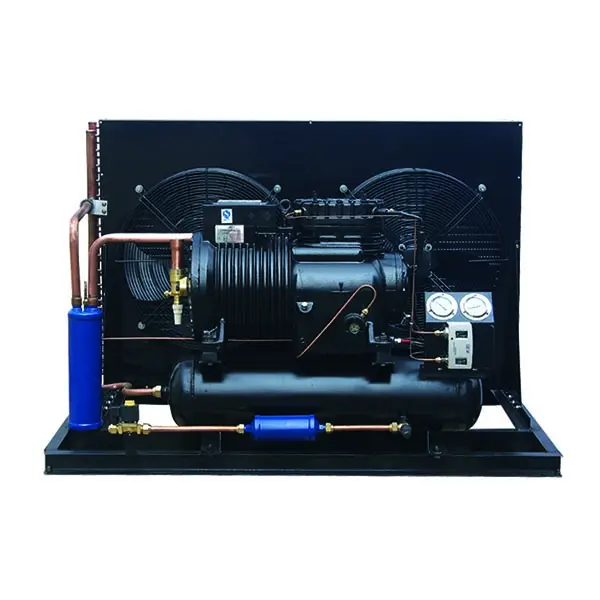
Many refrigeration problems start from incorrect equipment matching. A chiller may appear powerful enough on paper, but actual performance changes when evaporating temperature, condensing temperature, refrigerant type, and ambient conditions change.
For example, a cold room operating around -15℃ usually places different demands on the compressor and condenser than a beverage cooling process at 0~4℃. If the selected model is too small, the system may struggle to reach the target temperature. If it is oversized, the buyer may face unnecessary investment cost, poor cycling behavior, or inefficient operation.
Before selecting a water cooled chiller, buyers should confirm:
Required storage or process temperature
Product load and daily cooling load fluctuation
Evaporating temperature and condensing temperature
Available voltage and frequency
Refrigerant preference or local refrigerant regulation
Machine-room size and ventilation condition
Maintenance access and after-sales support requirements
Food-related refrigeration does not only require low temperature. It requires stable temperature control. In dairy, beverage, brewing, and cold storage applications, temperature fluctuation may affect product consistency, shelf life, and process reliability.
The product page highlights use cases such as raw milk storage, yogurt fermentation, commercial cold storage, wort cooling, and juice chilling. These are practical scenarios where stable medium-low temperature cooling is more important than simply reaching the lowest possible temperature.
Installation space is often limited in supermarkets, restaurants, small factories, and existing cold storage projects. A compact water cooled chiller can help reduce layout pressure, especially when the refrigeration system must be installed in a narrow machine room.
The product page states that compact models such as 2YG-3.2 are designed to fit into narrow machine rooms, with a listed size example of 827×330×660mm.
The product is described as using an iron compressor body, with cast iron and anti-rust coating mentioned in the material advantages section. For water-cooled refrigeration systems, moisture resistance and mechanical stability are important because equipment may operate in humid machine-room environments.
Different markets and projects may require different refrigerants. This product page lists compatibility with R22, R134A, R404A, R507C, and R407C. Buyers should confirm the final refrigerant choice based on local regulations, project temperature range, service availability, and long-term maintenance planning.
The evaporating temperature has a direct impact on cooling capacity. A model that performs well at 0℃ may deliver much lower capacity at -20℃. This is why buyers should avoid selecting a chiller only by nominal capacity.
The technical table on the product page lists refrigerating capacity and power consumption under different condensing temperatures and evaporating temperatures, which is the correct way to compare model performance.
Condensing temperature affects both cooling capacity and power consumption. If the cooling water temperature is high or water circulation is unstable, system efficiency may decrease.
For refrigeration projects, buyers should share the expected cooling water temperature, operating environment, and working hours with the supplier before final model selection. This allows the supplier to calculate a more realistic configuration instead of relying on ideal test conditions.
Different applications have different operating priorities.
For dairy and beverage storage, the main concern is stable temperature and food safety. For commercial cold storage, the buyer should consider door-opening frequency, warehouse volume, insulation quality, and product turnover. For brewing and food processing, process temperature stability and cooling speed may be more important.
The product page gives examples for dairy, commercial cold storage, brewing, and fruit juice processing, which makes this chiller more suitable for buyers looking for medium-low temperature refrigeration rather than ultra-low temperature freezing.
A compact unit is useful, but the installation should still leave enough room for piping, inspection, cleaning, and component replacement. Buyers should check unit dimensions, installation size, pipe connection size, and weight before confirming the purchase.
The product page lists model specifications including dimensions, installation size, pipe connections, and weight, which are important for engineering layout and transportation planning.
A lower purchase price may not mean lower total cost. If the unit is difficult to maintain, poorly matched to the refrigeration load, or inefficient under actual working conditions, operating costs can rise quickly.
Cooling capacity changes with evaporating and condensing conditions. Buyers should provide realistic project information, including target room temperature, product type, cold room volume, inlet product temperature, daily operating hours, and cooling water conditions.
Some refrigerants may be easier to service in one region than another. Before ordering, confirm whether local technicians can maintain the selected refrigerant system and whether the refrigerant complies with local environmental regulations.
For commercial refrigeration, downtime can directly affect stored goods and business operations. Buyers should ask about troubleshooting support, spare parts availability, warranty coverage, and remote technical guidance before purchase.
The product page states that customization, optional remote monitoring, warranty coverage, and troubleshooting support are available, including guidance for issues such as abnormal noise or the unit not starting.
A water cooled chiller is usually worth considering when the project has one or more of the following conditions:
The refrigeration system needs stable medium-low temperature cooling.
The installation site has reliable cooling water supply.
The machine room has limited space.
The project serves food, beverage, dairy, brewing, or commercial cold storage.
The buyer wants a refrigeration unit designed for continuous industrial or commercial use.
The project requires model selection based on detailed operating conditions.
It may not be the best option if the site lacks suitable water circulation conditions or if the project requires extreme deep-freezing beyond the product’s intended temperature range.
Choosing a water cooled chiller for refrigeration should start with the real application, not only the model name. For dairy, beverage, commercial cold storage, brewing, and food processing, buyers should confirm the required temperature range, cooling capacity, refrigerant, voltage, installation space, and service support before placing an order.
The Water Cooled Iron Chiller is positioned for medium-low temperature refrigeration and offers practical value for buyers who need stable cooling, compact installation, refrigerant flexibility, and project-based model selection. For the most accurate configuration, buyers should provide full operating conditions and request a model recommendation based on the technical capacity table rather than selecting only by nominal capacity.


