
close
Choose Your Site
Global
Social Media
Views: 0 Author: Site Editor Publish Time: 2026-01-28 Origin: Site


A semi-hermetic reciprocating compressor is a critical component in refrigeration systems, commonly used in industrial, commercial, and residential refrigeration applications. This type of compressor is known for its reliability, efficiency, and versatility, providing essential cooling solutions for various industries such as food processing, cold storage. The semi-hermetic design of the compressor allows for an efficient operation while maintaining durability and ease of maintenance.
A semi-hermetic reciprocating compressor operates by converting mechanical energy into refrigeration energy. The core functionality of a reciprocating compressor is based on its piston-driven mechanism, where pistons inside the compressor cylinder compress the refrigerant gas, raising its pressure before it is passed to the condenser. In semi-hermetic compressors, the motor and compression components are housed in a single, sealed unit that is only partially hermetically sealed. This design provides the advantage of offering easier access for repairs compared to fully hermetic compressors.
The semi-hermetic design typically includes a robust housing that can be opened for servicing, which reduces downtime and extends the compressor’s operational life. Compared to fully hermetic compressors, which require the entire unit to be replaced when problems occur, a semi-hermetic design allows for parts like valves, gaskets, and oil pumps to be replaced independently.
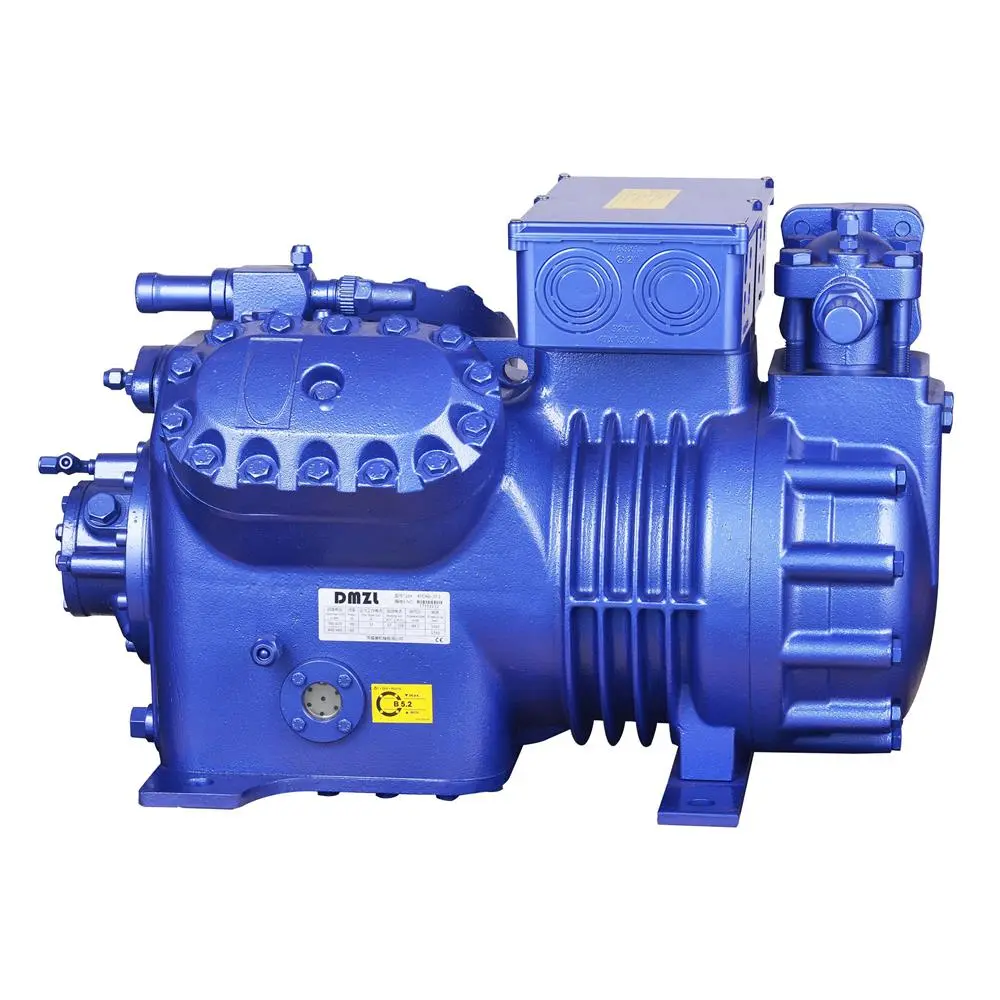
The operation of a semi-hermetic reciprocating compressor is relatively straightforward. The piston mechanism compresses the refrigerant gas within a cylinder. As the refrigerant is compressed, its pressure increases, causing the temperature of the gas to rise. This high-pressure, high-temperature gas is then sent to the condenser, where it releases its heat and is transformed into a liquid state. This liquid refrigerant is then expanded, causing it to evaporate, which cools the surrounding environment.
In a semi-hermetic compressor, the motor and compression components are housed together in one sealed unit. The "semi-hermetic" term refers to the fact that the housing is sealed but can be opened for service. This makes maintenance more convenient and cost-effective. In addition, the semi-hermetic design minimizes refrigerant leakage, which is critical for maintaining energy efficiency.
Efficiency: Semi-hermetic reciprocating compressors are known for their high efficiency, especially in applications requiring medium to high refrigeration capacity. Their efficient operation helps reduce energy costs and environmental impact.
Durability: These compressors are built to last, with many models offering a service life of 12–15 years when properly maintained. The robust construction of semi-hermetic compressors makes them resistant to wear and corrosion, extending their operational life.
Ease of Maintenance: The semi-hermetic reciprocating compressor can be opened for repairs, reducing downtime and maintenance costs compared to fully hermetic compressors.
Reduced Refrigerant Leakage: The design of semi-hermetic compressors minimizes refrigerant leakage, which enhances the overall energy efficiency of the system.
Adaptability: Semi-hermetic reciprocating compressors can handle varying load conditions, making them suitable for a wide range of applications, including refrigeration.
Versatility: These compressors are compatible with various refrigerants, such as R-22, R-404A, and R-507A, making them adaptable to different environmental conditions and regulatory standards.
1. Classification by Compression Stages:
Single-Stage Compressors
These compressors perform compression in a single stage. They are typically used for applications with moderate refrigeration demands, where a single compression step is sufficient to achieve the desired pressure levels. Single-stage compressors can come in 2-cylinder, 4-cylinder, or 6-cylinder designs.
Double-Stage Compressors
Double-stage compressors are designed for applications requiring low temperatures. The compression process is split into two stages, improving energy efficiency and reducing consumption. They are commonly used for deep-freezing applications or other low-temperature systems. Double-stage compressors typically come in 4-cylinder or 6-cylinder designs.
2. Classification by Cylinder Number:
Two-Cylinder Compressors
These compressors have two cylinders and are typically used in moderate refrigeration applications. Their design allows for efficient compression while maintaining a manageable size and capacity. These can be either single-stage or double-stage compressors.
Four-Cylinder Compressors
Designed for both moderate and heavy-duty applications, four-cylinder compressors are suitable for industrial refrigeration systems where varying cooling demands exist. They can be used in both single-stage and double-stage configurations.
Six-Cylinder Compressors
Built for high-capacity applications requiring substantial refrigeration power, six-cylinder compressors are often used in larger industrial settings where consistent, high-volume cooling is needed. They can also be found in both single-stage and double-stage designs.
A semi-hermetic compressor is partially sealed, allowing for easier maintenance and part replacement, while a hermetic compressor has a completely sealed housing and requires complete replacement if any part fails.
Semi-hermetic compressors are primarily used in medium to high refrigeration capacity applications, but they may not be suitable for extremely high-temperature applications.
Common refrigerants compatible with semi-hermetic compressors include R-22, R-404A, and R-507A, although newer models may also support more eco-friendly refrigerants like R-134A.
To ensure long-lasting performance, regular maintenance is essential. This includes checking and replacing oil, inspecting the valves and gaskets, and ensuring the compressor is running efficiently.
Two-stage semi-hermetic compressors are ideal for low-temperature refrigeration applications such as deep-freezing, vaccine storage, and industrial freeze-drying processes.
A semi-hermetic reciprocating compressor offers reliable, efficient, and durable performance in a wide range of refrigeration. Its robust design, ease of maintenance, and energy efficiency make it an ideal choice for industries that require consistent cooling. Whether used in industrial refrigeration, or cold storage, the semi-hermetic reciprocating compressor plays a crucial role in maintaining the integrity and functionality of refrigeration systems across various sectors.


